
Despite a steady collection rate, the government faces a steep Budget target of Rs 6.1 trillion for CGST for 2019-20.

Across 10 prominent services, revenue to the government reduced by 20 per cent in the first year of GST compared to the last year of the service tax regime. This happened despite tax liability against these services growing by 50 per cent in one year.

'Perhaps GST was too complex a system for the Indian economy at its present stage of development,' argues T N Ninan.

The states which achieved "extraordinary growth" in total taxes collected include Kerala (44 per cent), Jharkhand (20 per cent), Rajasthan (14 per cent), Uttarakhand (13 per cent) and Maharashtra (11 per cent), an official statement said.
The government on Monday projected a 16.67 per cent growth in gross tax revenue in the next fiscal beginning April 1, at over Rs 22.17 lakh crore. The revised estimates of gross tax revenue for the current fiscal has been pegged at Rs 19 lakh crore, lower than the Rs 24.23 lakh crore budgeted earlier. Economic Affairs secretary Tarun Bajaj said, "Our revenue figure is under-stated not overstated.
Many states are open to the idea of petrol and diesel being brought under the goods and services tax (GST) regime - contrary to the perception that they are averse to it - but they want a concrete proposal, including a compensation mechanism, from the Centre. West Bengal Finance Minister Amit Mitra says while the issue can be discussed, the Centre may not be keen to bring the change because it earns "much more" from taxes on petrol and diesel. "(The peak rate of) GST is 28 per cent. Under the regime, the Centre would only get 14 per cent. "So, definitely, the Union government does not want GST on fuel. It is all lies. Currently, they are in a very cozy place," Mitra said.
The Centre managed to collect only Rs 990 crore as compensation cess in April 2020-21, almost one-ninth of the figure of Rs 8,874 crore mopped up a year ago. The subdued collection would further increase states' problems unless the GST Council, which meets next week, decides to borrow from the market.

'The retail industry is still growing in double digits.'

The Trump trade shock is a chance to push long-overdue reforms, rather than tinker with tariffs to appease the US, suggests M Govinda Rao.
The buoyancy in the tax revenue of GST reflects the upswing in the economy and better compliance

Reliance General Insurance Company (RGIC), a subsidiary of Reliance Capital, finds itself in a bind as the Directorate General of GST Intelligence (DGGI) has issued multiple Show Cause Notices (SCNs) amounting to Rs 922.6 crore. This development comes at a time when Reliance Capital is currently undergoing a debt resolution under the National Company Law Tribunal (NCLT) process in which the Hinduja group has emerged the winner. The Hinduja acquisition is currently awaiting the Supreme Court's approval after the Torrent group, the winner of the first round, challenged the second auction conducted by the lenders of Reliance Capital.


Bajaj Finance, IndusInd Bank, State Bank of India, Maruti, Tata Motors, ITC, Tata Steel and Reliance Industries were also among the gainers. Nestle, NTPC, Kotak Mahindra Bank, Power Grid and Titan were among the laggards.
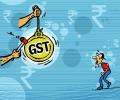
The GST intelligence unit detected tax evasion of more than Rs 1.98 lakh crore last year and arrested 140 masterminds who were involved in defrauding the exchequer, the finance ministry said on Thursday. In 2023, the Directorate General of GST Intelligence (DGGI) detected significant GST evasion in diverse sectors like online gaming, casinos, insurance and secondment (import of manpower services). "DGGI has achieved an increase in detection of cases of evasion and voluntary payments. In 2023, DGGI detected 6,323 cases involving evasion of duty of Rs 1,98,324 crore with a voluntary payment of Rs 28,362 crore.
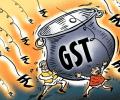
The shortfall in the Centre's GST collections has raised concerns over it meeting the fiscal deficit target of 3.3 per cent of GDP, reports Ishan Bakshi.

A road map could be laid out for a gradual reduction in the tax rates from the current incidence of about 62-94 per cent without causing a major blow to the revenues of the Centre and the states. The opportunity arising out of higher GST collections should not be squandered, says A K Bhattacharya.
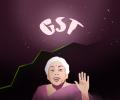
The GST Council on Saturday clarified that guarantees provided by corporate to their subsidiaries will attract an 18 per cent GST, while no tax will be levied if a personal guarantee is given by a director to the company. The council, chaired by Union Finance Minister Nirmala Sitharaman and comprising state ministers, also cut the GST rate on molasses to 5 per cent from 28 per cent. It also ceded the right to tax Extra Neutral Alcohol (raw product for making alcohol for human consumption) to the states.

GST authorities have issued show cause notices worth Rs 1 lakh crore to online gaming companies for tax evasion so far, a senior official said on Wednesday. The official, however, said there is no data yet of foreign gaming companies registering in India since October 1. The government has amended the GST law, making it mandatory for overseas online gaming companies to register in India from October 1.

It shows that states would require a compensation to the tune of at least Rs 1.67 trillion in 2024-25, as none of them would be able to achieve a 14 per cent growth every year.
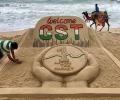
India's Goods and Services Tax (GST) collection surged to Rs 1.30 lakh crore in October, the second highest since its implementation in July 2017, indicating economic recovery from the COVID-19 pandemic and impact of festive demand, a finance ministry statement said on Monday. The highest GST collection of Rs 1.41 lakh crore was recorded in April 2021. This is the fourth time in a row when the GST collection was upwards of Rs 1 lakh crore. The collection from GST was Rs 1.17 lakh crore in September, 2021.

Finance ministry sources have countered CAG audit finding of central government wrongly retaining Rs 47,272 crore of GST compensation cess meant for states, saying temporary retention cannot be termed as diversion.
The CAG has found that the Union government in the very first two years of the GST implementation wrongly retained Rs 47,272 crore of GST compensation cess that was meant to be used specifically to compensate states for loss of revenue.

Ehile the Centre had projected tax revenues to touch 12.1 per cent of GDP in FY19, Revised Estimates peg the collections at 11.9 per cent, owing to a shortfall in the goods and service tax (GST) collections, reports Ishan Bakshi.
A well-established tax system would have a predictable buoyancy - how fast the collections grow as a proportion to the growth of the economy. But that is not the case with GST. It is still undergoing substantial changes as the government responds to structural as well as administrative glitches.
Finance Minister Nirmala Sitharaman on Thursday said taxpayer base has almost doubled to 1.28 crore in four years of rollout of the historic tax reform and the enhanced GST mop up in the recent months should now be the "new normal". In a written message to tax officers on the fourth anniversary of GST rollout, she said implementing any reform of this scale in a large and diverse country like India can be highly challenging, but GST has brought about ease in taxpayer compliance and reduced common man's tax burden.

If the new regime is introduced in 2017, the govt may lose out on cess, surcharge

Large states like Andhra, Chhattisgarh, Gujarat, Himachal, MP, Odisha, Punjab and Tamil Nadu would need compensation from the Centre
Can this growth in GST collection be sustained in the coming years? asks A K Bhattacharya.

Foreign companies now pay less tax relative to their earnings than at any time in more than three decades. Foreign private companies paid 24.36 per cent of their pre-tax profit as tax in 2023-24, show numbers from the Centre for Monitoring Indian Economy (CMIE).

It is possible that the Centre has now become wiser and has decided to follow an allocation system which gives it more from Integrated GST and helps boost its revenues, says A K Bhattacharya.

Online sports platform Mobile Premier League has laid off around 350 people or about half of India team to cut down on expenses and bear the burden of increased GST of 28 per cent, according to an internal company email. The GST Council has decided to levy a 28 per cent GST on online gaming and casinos on the face value of bets at the entry level. The Centre will bring amendments to the Central GST law in the ongoing monsoon session of Parliament, following which states will pass the amendments in their respective assemblies to pave the way for the introduction of changes in the law by October 1.

Taking both direct and indirect taxes, the gross collection is expected to grow 10.45 per cent to Rs 33.61 trillion in 2023-2024.
Taiwan in 1951 came up with an ingenious plan to improve tax compliance: citizens taking receipts for purchases could use them as lottery tickets. Customers were incentivized, and businesses found it hard to evade taxes. The plan's success prompted other countries, Slovakia and Greece among them, to launch similar initiatives. India doesn't seem to find the need yet for such schemes amid surging goods and services tax (GST) collections.
Overhaul of the goods and services tax (GST) structure, including possible changes in the tax slabs, may now be taken up only after the 2024 Lok Sabha elections, given the number of states that are going to the polls in its run-up. "No major overhaul of tax rates is expected in GST until the end of next fiscal year. One major reason for this is that some members of the group of ministers (GoM) - mandated to look at rate rationalisation by the GST Council - are from poll-bound states. Later, this may lead to reconstitution of the panel," a senior government official told Business Standard. Besides, both the Centre and states are not in favour of frequent changes in the tax rates amid inflationary uncertainties; they believe any major change should be brought in after extensive deliberations, according to the official.

The Centre on Tuesday permitted 20 states to raise Rs 68,825 crore through open market borrowings to bridge the GST revenue shortfall.

For every rupee in the government coffer, the biggest pie of 66 paise will come from direct and indirect taxes, according to the Union Budget 2025-26 documents. Around 24 paise will come from borrowings and other liabilities, 9 paise from non-tax revenue like divestment, and 1 paise from non-debt capital receipts, the Budget documents said.

At least 120 insurance intermediaries and aggregators from across the country are under scrutiny, mainly from Mumbai, Gurugram and Bengaluru.

The panel of state finance ministers is likely to recommend a uniform GST levy of 28 per cent on online gaming irrespective of whether it is a game of skill or game of chance, sources said. However, it is likely to suggest a revised formula for calculating the amount on which the Goods and Services Tax (GST) would be levied. Currently, online gaming attracts 18 per cent GST.

The data primarily pertains to activities in March, which had only a few days under the Covid-19 lockdown. For April , hence, CGST collections could be much lower, fear analysts.

Dream11, Baazi Games, Zupee and WinZO among others are invited for the discussion with the anti-money laundering watchdog.
